
Most restaurants set the price of their dishes using the chef's intuition and what competitors charge. The result: dishes that seem profitable but lose money when ingredient costs rise, and a menu without a single up-to-date recipe cost card. Kitchen Stocker changes that with a recipe module connected to inventory in real time.
What's included
- Recipe cost cards with ingredients and quantities
- Dish cost updated in real time
- Theoretical vs. actual food cost
- Alert when cost exceeds the defined threshold
- Recipe scaling for large quantities
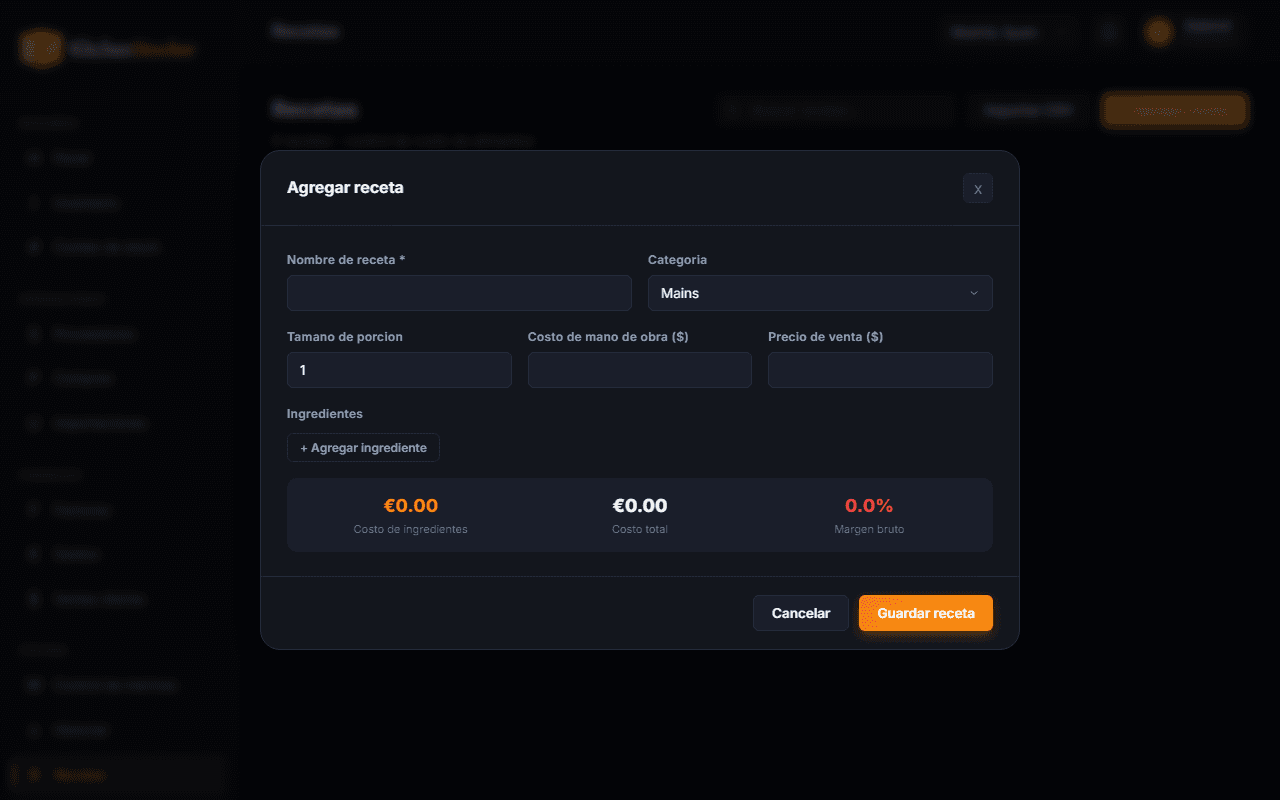
Recipes & Food Cost · app.kitchenstocker.com
How it works
Create the recipe cost card
Add the recipe's ingredients with their exact quantity in the unit you use in the kitchen. Kitchen Stocker converts automatically between units (kg, g, litres, units).
Cost is calculated automatically
Kitchen Stocker takes the current cost price of each ingredient from inventory and calculates the dish's food cost in euros and as a percentage of the selling price.
Price changes propagate automatically
When an ingredient's price rises (due to a new supplier invoice), the cost of every dish containing it updates without any action needed.
Compare theoretical with actual
The system calculates how much should have been consumed based on sales (theoretical food cost) and compares it with actual inventory consumption. The difference reveals waste and incorrect portions.
Who is this module for?
Executive chef
Designs the menu with real cost data. Adjusts ingredients or portion weights to keep food cost within target without changing the price for customers.
Owner
Receives an alert when a dish's cost exceeds the defined threshold, without having to review recipe cost cards manually every week.
Operations director
Uses theoretical vs. actual food cost to detect which kitchens have portioning problems or ingredients going missing without being logged.
Frequently asked questions
What is the difference between theoretical and actual food cost?
Theoretical food cost calculates how much should have been consumed based on the period's sales and the recipe cost cards. Actual food cost is what inventory shows was effectively consumed. The difference indicates waste, portioning errors or unregistered consumption.
Can I use the same recipe for several presentations of a dish?
Yes. You can create sub-recipes (bases, sauces, stocks) and reuse them as an ingredient in other recipe cost cards. The cost cascades through automatically.
Can I scale a recipe for banquets or batch production?
Yes. Recipe scaling automatically multiplies the ingredients by the number of portions you need.
What is a reasonable food cost target for a restaurant?
It depends on the type of restaurant and the desired margin. As a reference, a food cost of 28–32% of the selling price is common in à-la-carte restaurants in Spain. Kitchen Stocker lets you configure the threshold that fits your model.
Other Kitchen Stocker modules
Start free with Recipes & Food Cost
No credit card. No installation. Cancel anytime.